ICSITreatment
In standard IVF, sperm must fertilise the egg unassisted. In ICSI, our embryologist selects one healthy sperm under high magnification and injects it directly into the egg — a technique used worldwide since 1992, and the standard approach whenever sperm numbers or quality are very low. 70–85% Fertilisation Rate. 1 Per Egg Sperm Needed.
Understanding ICSI Treatment
In conventional IVF, prepared sperm and eggs are placed together in a dish and fertilisation is left to happen naturally. ICSI removes that uncertainty. An embryologist selects a single healthy, motile sperm, immobilises it, and injects it directly into a mature egg using a glass needle finer than a human hair, under high magnification.
The reason it exists is straightforward. Fertilisation has several stages at which sperm can fail: reaching the egg, binding to its outer shell, penetrating it, and fusing with the inner membrane. Where sperm count is very low, movement is poor, or shape is abnormal, one of those stages may never happen — and in a conventional dish the result is no fertilised eggs at all, discovered only the next morning.
ICSI bypasses every one of those hurdles. It is the reason men with no sperm in the ejaculate, whose sperm must be retrieved surgically, can still father their own genetic children: a small number of viable sperm is enough, because only one is needed for each egg.
Expectations should be set honestly. ICSI solves the fertilisation step and typically fertilises around seven to eight of every ten mature eggs injected. It does not improve egg quality and cannot guarantee a good embryo — a fertilised egg still has to divide correctly and reach blastocyst. It is a precise solution to a specific problem, recommended when there is a clear reason for it rather than applied by default.
When To Consider This
Severe male factor infertility — low count, poor motility or abnormal shape
Few or no eggs fertilised in a previous IVF cycle
Sperm retrieved surgically via PESA, TESA or Micro TESE
Frozen or very limited sperm samples, where every sperm counts
PGT or donor egg cycles, where stray sperm DNA must be avoided
Seek Care Promptly If
- Severe bloating or pain during the stimulation phase (possible OHSS)
- Fever after egg retrieval
- Heavy bleeding following the procedure
What's Involved
Expert Video Guides
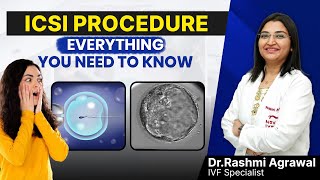
ICSI Explained: One Sperm, One Egg

Twins After Repeated Disappointment Elsewhere

Motherhood After 4 Years
Frequently Asked Questions
In IVF, thousands of sperm are placed around each egg. In ICSI, a single sperm is injected directly into the egg. ICSI is standard when sperm numbers or quality are very low.
Large studies show only a small increase in risk, largely linked to the underlying male infertility itself rather than the ICSI procedure. We discuss this openly, and genetic counselling is available where relevant.
Yes. ICSI is often the preferred method with frozen or previously frozen samples, since it only requires a single viable sperm per egg.
There is no single cutoff — motility and morphology matter as much as count. We review your full semen analysis and recommend ICSI whenever conventional fertilisation looks unreliable.
More mature eggs improve the odds of at least one good embryo, but success has been achieved with as few as one or two. Your stimulation protocol is planned around your ovarian reserve.